
We-media is the product of the rapid development of information and communication technologies. It is a channel used by the general public to release their own opinions based on what they have experienced through advanced digital technology (Bowman et al., 2003).
In China, We media as a new form of the job has a great potentiality in recent days. As one of the most active environments for social media, China has more than 300 million users from blogs to social networking sites and other online communities. Besides, it is over 40 percent of Chinese online users that they spend on social media, and this figure continuously rises (Chiu et al., 2012). Under the influence of this huge market environment, more and more Chinese are starting to consider self-media as a serious job, and a number of young people are willing to try this new way of working.
Even though self-media is an emerging profession, the digital economy has a significant influence on it. The digital economy is an arrangement of monetary and social relations dependent on the utilization of data and correspondence innovations (Pashchenko, 2018), which plays a positive role in promoting the development of We media. Firstly, before the digital economy emerging, the first wave of We media’s advancement in China was credited to the ascent of the blog. It was the first occasion when conventional individuals in China got the chance to communicate their own voice somewhat. Such a significant number of popular people and common individuals made their own blog account to share their opinions and sentiments about public affairs with the purpose of disseminating information (Xia, 2017). However, as time goes by, the main aim and function of We media have transformed from sharing information into making money. In other words, users who set up We media accounts are expecting to obtain commercial interests in ongoing 5 years in China (Gao, 2015). The decent income and seemingly light workload become the biggest incentive to attract more younger generation considering We media as a lifelong job, which is another change in job nature from part-time to full-time.
In addition, the form of We media also has a tremendous change according to the development of the digital economy. In the beginning, the most common forms are articles and pictures in the previous posts. As a result of accelerating the pace of life, a clip of a short video can easily capture viewers’ attention more than a long article. Therefore, a dynamic short video takes place of static texts and become the mainstream format of self-media.For example, the quantity of day by day dynamic clients on Douyin, the most well-known short video application in China, had ascended to 400 million by January. Such an accomplishment is amazing, taking into account that the application made its introduction in 2016 (China Daily, 2020). A vivid short video clip is more attractive and saving time than lengthy text for audiences who live in the fast pace of life.
Although We media as a rising career has a brilliant prospect, it still remains at an unmatured stage coexistence of low entrants’ barriers, a flood of low-quality content, serious homogenization phenomenon. In today’s situation, We media users pay more attention to increasing loads of internet traffic regardless of consequences.
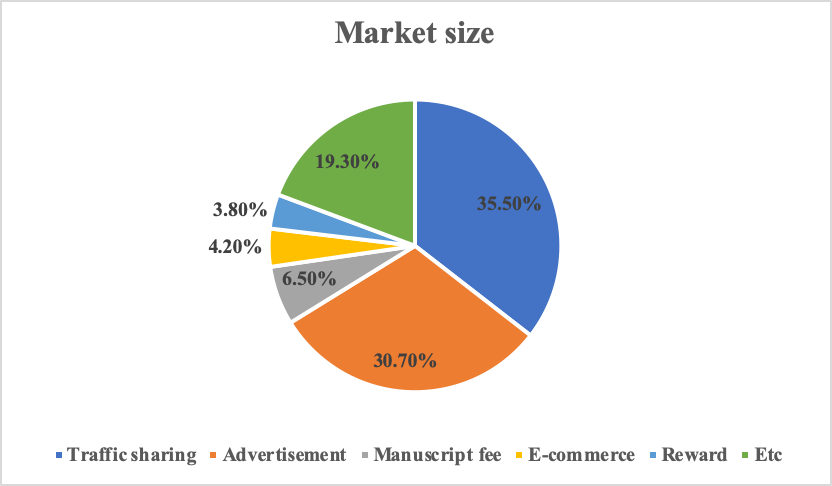
However, with the further development of society and the economy, it is high-quality contents that is the essential key to maintain steady consumption. So, those contentless and grandstanding information post by We media practitioners recently will be eliminated in the future. Every We media producer will release valuable information to the audience in the position of shouldering social responsibility instead of from a company standpoint. Besides, with stricter social supervision, every piece of information post will have the quality assurance to ensure the accuracy of the content in order to avoid defamation and plagiarism.
From the perspective of We media workers, they would focus on developing specific skills, which means the We media will become more and more specialization. In the future, it is hardly possible for a We media worker to across multiple domains because of increasing new entrants’ barriers. For example, as a self-media practitioner in tourism, he not only needs to write interesting texts to show rich contents about a tourist destination in short videos but also keeps exploring new tourist attractions for viewers. However, possession with those capabilities is not enough for a brilliant trip We media worker. He also needs to creative no matter the contents or video form, which is a vital element to impress viewers. He should find more niche tourist locations which audiences haven’t heard about, or from different aspect to explore a popular tourist attraction.
With the further advancement of digital marketing, We media has a great development prospect. Even though it is still in an unstable, incomplete and imperfect stage, all high-quality and innovative We media workers will survive through the social environment.
Sources
Bowman, S., & Willis, C. (2003). We media. How audiences are shaping the future of news and information, 66.
China Daily. (2020, January 7). Retrieved February 13, 2020, from http://www.chinadaily.com.cn/m/beijing/zhongguancun/2020-01/07/content_37531689.htm
Chiu, C., Ip, C., & Silverman, A. (2012, April). Understanding social media in China. McKinsey & Company. Retrieved from https://www.mckinsey.com/business-functions/marketing-and-sales/our-insights/understanding-social-media-in-china
Gao S, Krogstie J (2015) Understanding business models of mobile ecosystems in China: a case study. In Proceedings of the 7th International Conference on Management of Computational and Collective Intelligence in Digital Ecosystems 64-71.
Pashchenko, A. F. (2018). Use of Network-Centric Principles in Digital Economy Technologies. 2018 Eleventh International Conference “Management of Large-Scale System Development” (MLSD, Management of Large-Scale System Development (MLSD), 2018 Eleventh International Conference, 1–5. https://doi.org/10.1109/MLSD.2018.8551776
Xia, S. (2017). A Study on the Profit Model of We Media in China. Global Media Journal, 15(28).
 Star of Tomorrow
Yes, I agree with your idea. We Media will have enormous developmental potential. We Media enables everyone to have their voice and is a channel to convey points of view and values. It offers many job opportunities. However, for the individual perspective, most of them do not have a regular wage. Most We Media writers cannot poss the national insurance contribution that is from the government. It means that they potentially lack pensions and healthcare compared to other employees. As a result, We Media may not be a sustainable and stable job for someone. For the government, some low-grade and illegal content happens. It is not enough to rely on social supervision. We Media require the Chinese government to spend time on more well-established laws and legislation to restrain and provide a sustainable working environment for We Media writers and readers.
赞赞
Definitely, I agree with your opinion. I think your idea give me some new information I did not take into account. I only realize the bright side of We media, such as millions of money a We media can earn, but I did not find out that some job fields in We media can not make a living, even can not protect their own rights, just like you said, We media writers.
赞赞